

 https://doi.org/10.4081/cc.2026.15930
New-onset cervical pain followed by ophthalmoplegia revealing cavernous sinus meningioma
All claims expressed in this article are solely those of the authors and do not necessarily represent those of their affiliated organizations, or those of the publisher, the editors and the reviewers. Any product that may be evaluated in this article or claim that may be made by its manufacturer is not guaranteed or endorsed by the publisher.
Published: 23 September 2026
Background: Headache and facial pain may occur in patients with meningioma, but their diagnostic significance is often underestimated when pain resembles a primary headache phenotype or occurs in a patient with a long-standing history of tension-type headache. Cavernous sinus meningiomas are particularly relevant in headache medicine because of their proximity to the oculomotor nerves, trigeminal branches, internal carotid artery, and parasellar structures.
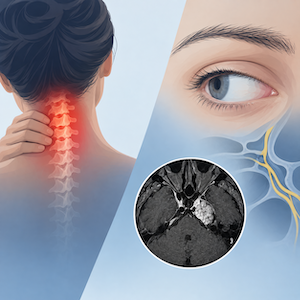
Case Report: A 62-year-old woman with a 30-year history of tension-type headache presented with a 1-month history of severe cervical pain, initially interpreted in the context of her previous headache disorder and treated with amitriptyline at a dose of 10 mg/day, administered at bedtime for 2 weeks, without clinical benefit. She subsequently developed acute vertical diplopia. Neurological examination revealed mild left ptosis, left ocular deviation, and impaired elevation of the left eye, consistent with partial left oculomotor nerve palsy. She also reported a transient cold sensation in the left maxillary territory. Contrast-enhanced brain MRI showed a homogeneously enhancing extra-axial lesion in the left cavernous sinus, extending toward the superior orbital fissure and lying close to the intracavernous segment of the internal carotid artery, compatible with cavernous sinus meningioma. No previous brain MRI or CT was available for comparison.
Discussion: The association of a new, refractory cervical pain with acute ocular motor dysfunction and ipsilateral trigeminal sensory symptoms supported a secondary pain disorder rather than a simple fluctuation of the patient’s previous tension-type headache. Cavernous sinus meningioma should be considered in the differential diagnosis of new-onset cervical pain followed by ophthalmoplegia, particularly when oculomotor nerve palsy is accompanied by trigeminal sensory symptoms.
Conclusions: This case highlights a clinically relevant diagnostic pitfall in headache practice: a new or changed pain phenotype in a patient with a known primary headache disorder should prompt reassessment for secondary causes, especially when cranial nerve signs emerge.
Downloads
1. Schankin CJ, Krumbholz M, Sostak P, Reinisch VM, Goldbrunner R, Straube A. Headache in patients with a meningioma correlates with a bone-invasive growth pattern but not with cytokine expression. Cephalalgia 2010;30:413-24. DOI: https://doi.org/10.1111/j.1468-2982.2009.01945.x
2. Toro J, Burbano LE, Reyes S, Barreras P. Cavernous sinus syndrome: need for early diagnosis. BMJ Case Rep 2015;2015. DOI: https://doi.org/10.1136/bcr-2014-206999
3. Corniola MV, Roche PH, Bruneau M, Cavallo LM, Daniel RT, Messerer M, et al. Management of cavernous sinus meningiomas: Consensus statement on behalf of the EANS skull base section. Brain Spine 2022;2:100864. DOI: https://doi.org/10.1016/j.bas.2022.100864
4. He W, Liu Z, Zheng D, Xu C, Jie D, Tang L, et al. Management of cavernous sinus meningiomas: Clinical features, treatment strategies, and long-term outcomes. Asian J Surg 2024;47:1366-77. DOI: https://doi.org/10.1016/j.asjsur.2023.12.002
5. Elahi F, Ho KW. Successful Management of Refractory Headache and Facial Pain due to Cavernous Sinus Meningioma with Sphenopalatine Ganglion Radiofrequency. Case Rep Neurol Med 2014;2014:923516. DOI: https://doi.org/10.1155/2014/923516
6. Headache Classification Committee of the International Headache Society (IHS) The International Classification of Headache Disorders, 3rd edition. Cephalalgia 2018;38:1-211. DOI: https://doi.org/10.1177/0333102417738202
7. Do TP, Remmers A, Schytz HW, Schankin C, Nelson SE, Obermann M, et al. Red and orange flags for secondary headaches in clinical practice: SNNOOP10 list. Neurology 2019;92:134-44. DOI: https://doi.org/10.1212/WNL.0000000000006697
8. Nidamanuri P, Shastin D, Nannapaneni R. Cavernous sinus meningioma presenting as third nerve palsy in pregnancy. BMJ Case Rep 2018;2018. DOI: https://doi.org/10.1136/bcr-2017-223152
9. Gone J, Kennedy B, Fontaine T, Szilagyi S. Creeping through the cranium: A rare and interesting presentation of a meningioma. Radiol Case Rep 2024;19:3928-33. DOI: https://doi.org/10.1016/j.radcr.2024.05.088
10. Heth JA, Al-Mefty O. Cavernous sinus meningiomas. Neurosurg Focus 2003;14:e3. DOI: https://doi.org/10.3171/foc.2003.14.6.3
11. Marta GN, Correa SF, Teixeira MJ. Meningioma: review of the literature with emphasis on the approach to radiotherapy. Expert Rev Anticancer Ther 2011;11:1749-58. DOI: https://doi.org/10.1586/era.11.162
12. Correa SF, Marta GN, Teixeira MJ. Neurosymptomatic carvenous sinus meningioma: a 15-years experience with fractionated stereotactic radiotherapy and radiosurgery. Radiat Oncol 2014;9:27. DOI: https://doi.org/10.1186/1748-717X-9-27
How to Cite

This work is licensed under a Creative Commons Attribution-NonCommercial 4.0 International License.
PAGEPress has chosen to apply the Creative Commons Attribution NonCommercial 4.0 International License (CC BY-NC 4.0) to all manuscripts to be published.